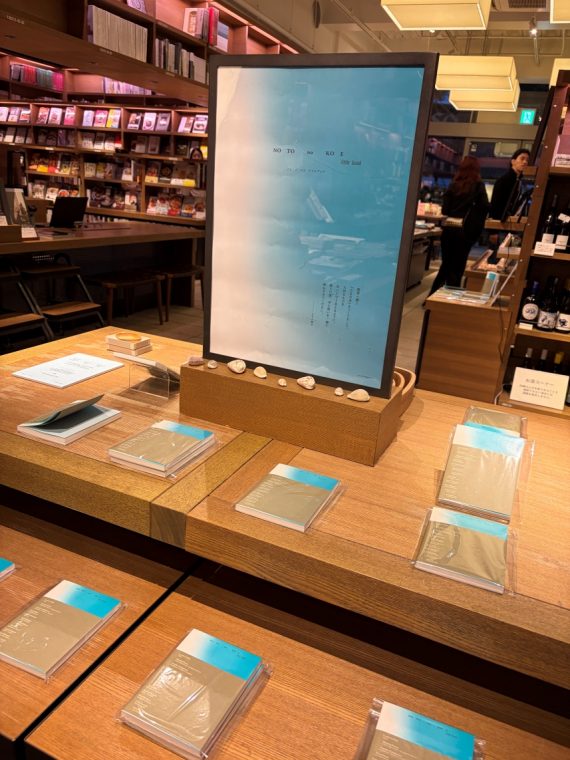
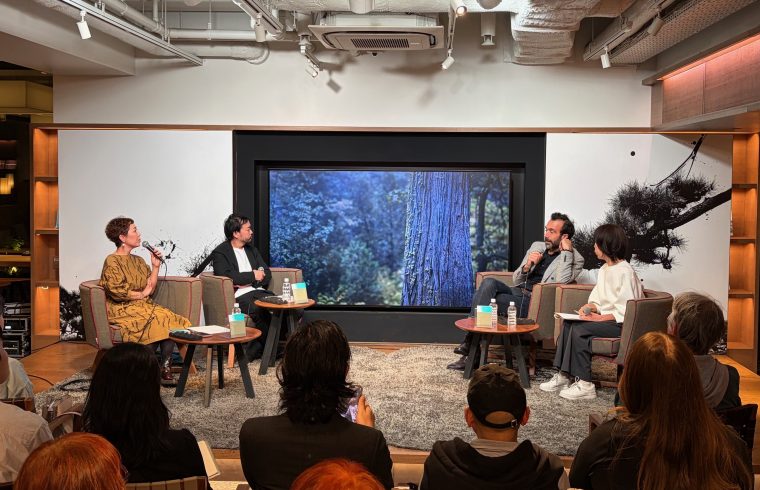
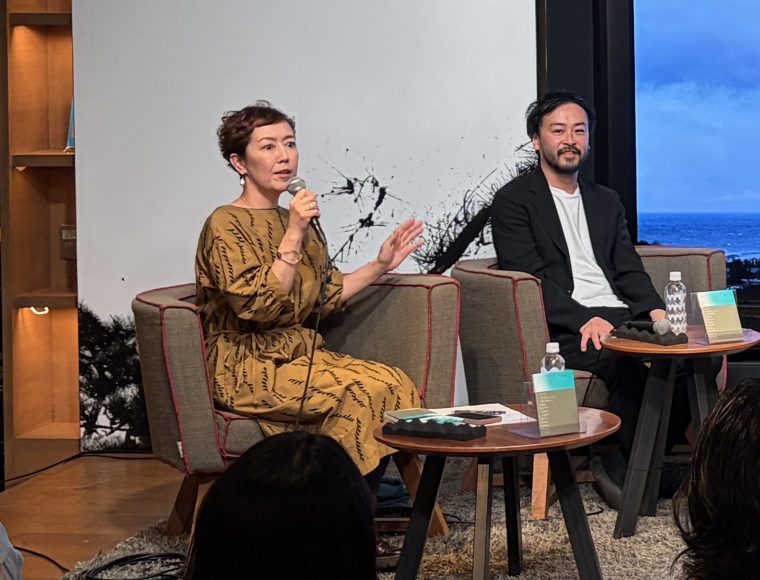
On Tuesday, April 14, 2026, a talk event was held at Daikanyama Tsutaya Bookstore to commemorate the release of the Notonokoe Little Book.
The facilitator is Tomoko Chris, and the guests are Chef Meiju Hirata of Villa Della Pace, Chef Lionel Beccat, and food coordinator and interpreter Kanako Teshigawara.
Chef Lionel first met Chef Hirata in 2018 when he visited Noto to prepare for a collaborative event. “I was captivated by the light and scenery of Noto,” he said. Looking at the many photographs he has taken since then, Chef Hirata says, “It made me realize again what a wonderful place we live in.” The venue was decorated with photographs of Chef Lionel, and they were also projected onto the backs of the four seats, allowing the participants to enjoy the talk while looking at the beautiful sea, sacred forests, and trees.
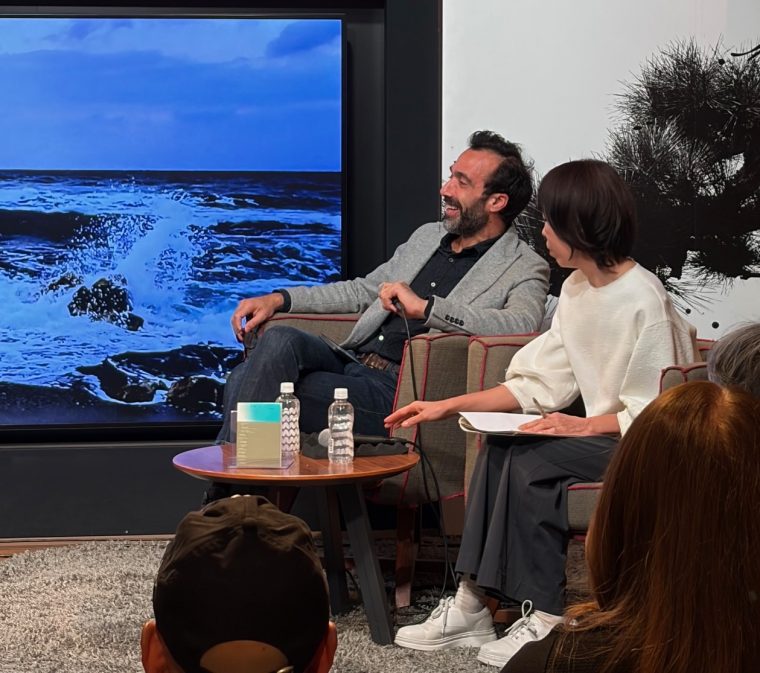
When asked about the challenges facing Noto before and after the earthquake, Chef Lionel said that while government intervention is fundamentally necessary, he believes there is meaning in showcasing beauty. He noted that while much of the information available may fuel anxiety, this book conveys beauty and important things. He stated that he is expressing values that are not measured in money or similar terms.
“Noto-no-koe” began in May 2024 with an event at Esquisse in Ginza, featuring Chef Hirata, Chef Toshiya Ikehata of L’Atelier de Noto, lacquer artist Akito Akagi, and Yutaka Kitazaki of Soma-michi. They discussed in depth how to convey the voices of Noto, given the painful scars left by the earthquake, a situation that had only just begun with the relief efforts. Chef Hirata said that “the May event was a light and hope.” And, as if guided by the words “Noto-no-koe,” a second and third event were held in Noto, and now “Noto-no-koe Little Book” has been born.
Chef Lionel was impressed by Chef Hirata’s move from Tokyo to Noto, and his attitude of confronting the question of how to convey the voice of the ingredients while being close to nature and the ingredients themselves. He said that he was very courageous and that he was the same type of chef as himself.
Chef Hirata lives in Noto and, as he learned about the region’s unique food culture through its events and festivals, he came to appreciate the depth and fascination of its history. Feeling a sense of crisis that Noto’s culture was being lost after the earthquake, he began developing “Noto Kyogei Ryori ” last year, a style of cuisine that is not bound by Italian conventions, but draws inspiration from rural and fishing village cooking. It is a type of cuisine that can only be made in Noto. Although the earthquake was the catalyst, it brought about a change within him, and he says he is now able to do what he has always wanted to do.
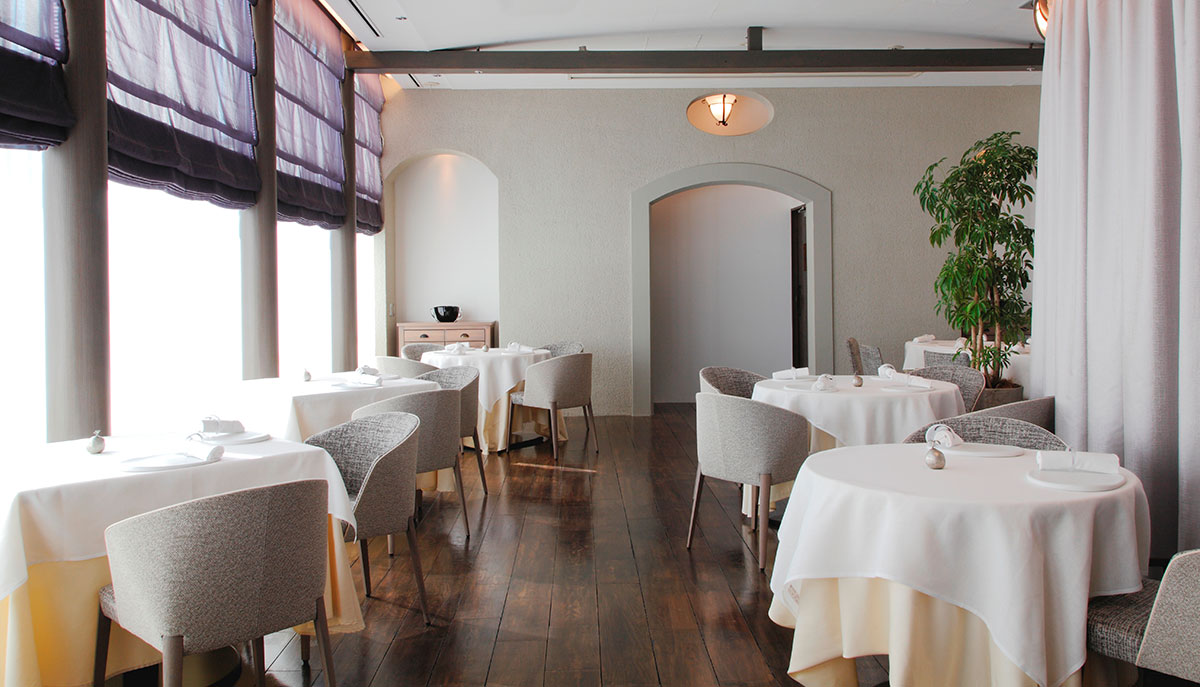
According to Kanako Teshigawara, for gourmets, the standard route was from L’Atelier de Noto in Wajima to Pace in Nanao. However, Wajima suffered a major blow, and L’Atelier de Noto was half-destroyed. Many people who had come from other prefectures out of curiosity have now settled down, and it seems that very few people will be visiting Noto from 2025 onwards. She conveyed her hope that many people will visit, not only for Pace but also for the hot springs in Nanao.
The Notonokoe Little Book was originally a self-published project by Chris Tomoko, Lionel Chef, and Kanako Teshigawara, but many people contributed their efforts, including editor Yosuke Fujiki, designer Koji Miyazoe, and translator Alexander Smith. (Apparently, the cover design concept for the “Little Book” is “light.”)
It was mentioned that prominent figures such as Kaori Ishii (film director/producer) readily agreed to contribute articles, photographs, and illustrations. They expressed their gratitude to everyone. Furthermore, Chris Tomoko served as a guidepost for conveying the “voices of Noto,” and Teshigawara expressed her thanks to her.
We also received a message from director Kahori Ishii, who was present at the venue.
“In Noto, there are things that have not been lost. Even though buildings have been destroyed and people have left, there is still hope for those who continue to live there. In 15 or 20 years, it may face the problem of depopulation, but if it weren’t for the earthquake, it would have simply disappeared without a sound. The earthquake was cruel, but the locals feel that it has attracted attention and that different people than before are now showing interest in Noto. There may be some opportunity there, and some say it’s like they’ve picked up a different clock.”
In January 2024, people who had experienced the Great East Japan Earthquake were already in various regions. In Tohoku, reconstruction is being rushed, and there are times when people wonder if this is the kind of reconstruction they wanted. They want to consider whether people will want to live there in 10 or 20 years, and whether it will have the unique character they desire in Noto. While the reconstruction is slow, it would be good if it could be done carefully and positively. I think it would be good if not only the people of Noto but also people from outside could be actively involved.
Finally, Chris Tomoko concluded the talk event by saying that it’s good for each person involved to think about what they can do, and that if you’re wondering “Should I go?”, you should just go and see what you feel for yourself. She encouraged everyone to go and enjoy themselves.